Got a lump sum sitting in your savings account? Just received a bonus, an FD matured, or maybe you inherited some money? Instead of letting it earn measly bank interest rates, what if you could invest it once, get life insurance coverage, and potentially grow it through bonuses – all without ever having to pay another premium?
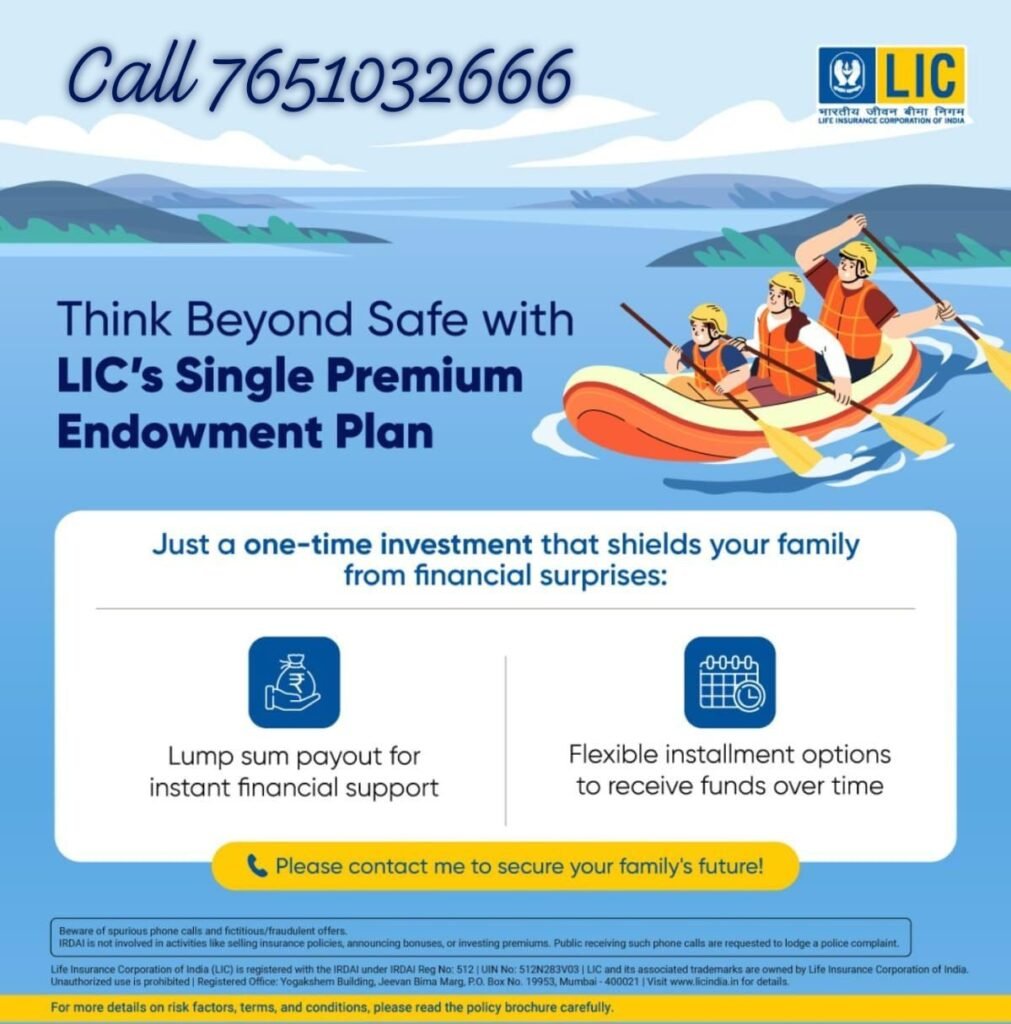
That’s exactly what LIC Single Premium Endowment Plan offers: pay once, and you’re done. No annual reminders, no monthly ECS debits, no worrying about premium payment lapses. Just one payment at the start, and then you sit back and let your money work for you.
What Is LIC Single Premium Endowment Plan?
LIC Single Premium Endowment Plan (Plan 917) is a traditional savings-cum-insurance plan with one unique feature: you pay the entire premium upfront in a single payment. That’s it. No more payments ever.
In return, you get:
- Life insurance coverage for the entire policy term (10 to 25 years)
- Guaranteed sum assured at maturity if you survive the term
- Bonuses that LIC adds to your policy year after year
- Tax benefits on your investment and maturity proceeds (subject to conditions)
Think of it as a long-term fixed deposit with life insurance built in, but instead of fixed interest, you get bonuses declared by LIC based on the plan’s performance.
How Does “Single Premium” Actually Work?
Let’s make this crystal clear with an example:
Traditional Insurance: You commit to a ₹10 lakh policy. LIC says, “Pay ₹50,000 every year for 15 years.” Total you’ll pay: ₹7,50,000 over 15 years.
Single Premium Plan: You commit to a ₹10 lakh policy. LIC says, “Pay ₹6,50,000 once. You’re done.” Total you’ll pay: ₹6,50,000, right now.
The single premium amount is calculated actuarially to equal what you’d pay over time, but compressed into one payment. You typically pay less in total (since LIC doesn’t need to account for future uncertainties), and you never have to think about premium payments again.
Why Would Someone Choose This?
1. You Have a Lump Sum Available
This plan is perfect when you have money that needs deploying:
- Annual bonus or incentive from work
- Fixed deposit maturing and you want better returns
- Inheritance or gift that you want to grow safely
- Sale proceeds from property or assets
- NRI remittance or foreign income being brought to India
- Retirement corpus that you want to partially protect and grow
Instead of this money sitting idle or earning 5-6% in a savings account, you invest it once and potentially grow it while getting life cover.
2. You Hate Annual Premium Hassles
Be honest – how many times have you:
- Forgotten to pay a premium and worried about policy lapsing?
- Scrambled to arrange funds when the premium notice arrived?
- Felt the annual burden of “another insurance premium due”?
With a single premium plan, you never face these problems. Pay once, and the policy runs automatically for the entire term.
3. You Want Certainty and Simplicity
Some people love complex investment strategies. Others just want simplicity: “I’ll put this money here, and in 15 years, I’ll get my money back with bonuses plus I’m covered if something happens.”
If you’re in the latter category, this plan delivers exactly that clarity.
Understanding the Two Types of Benefits
If You Survive the Policy Term (Maturity Benefit)
Let’s say you take this plan at age 40 for a 20-year term with a ₹10 lakh sum assured by paying a single premium of ₹7 lakhs.
At age 60 (maturity), you receive:
- Your ₹10 lakh basic sum assured (guaranteed)
- Plus all simple reversionary bonuses accumulated over 20 years
- Plus final additional bonus (if LIC declares one at maturity)
Example calculation: If LIC declares an average bonus of ₹50 per ₹1,000 sum assured each year:
- Annual bonus addition: ₹50,000 (on ₹10 lakh)
- Over 20 years: ₹10,00,000 in bonuses
- Final additional bonus: Let’s say ₹2,00,000
Total maturity amount: ₹10,00,000 + ₹10,00,000 + ₹2,00,000 = ₹22,00,000
You invested ₹7 lakhs once; you get back ₹22 lakhs after 20 years. Not bad for a risk-free, tax-efficient investment.
If Something Happens to You (Death Benefit)
Life insurance is ultimately about protecting your family. If you pass away during the policy term, your nominee receives:
Sum Assured on Death (which depends on your age when you took the policy):
- Below age 50: Higher of Basic Sum Assured OR 1.25 times your single premium
- Age 50 and above: Higher of Basic Sum Assured OR 1.10 times your single premium
Plus:
- All bonuses accumulated till date of death
- Final additional bonus (if applicable)
Using our earlier example, if you’re 40 and paid ₹7 lakhs:
- Sum Assured on Death = Higher of ₹10 lakhs OR ₹8.75 lakhs (1.25 × ₹7L) = ₹10 lakhs
- Plus accumulated bonuses till death
- Your family gets substantial financial support exactly when they need it most
The Bonus Structure Explained
Since this is a “participating” plan, you share in LIC’s profits through bonuses. Here’s how it works:
Simple Reversionary Bonuses
LIC declares these regularly (typically annually). Once declared and added to your policy, they’re yours permanently. They keep accumulating throughout the policy term.
For example:
- Year 1: ₹50 per ₹1,000 added
- Year 2: ₹52 per ₹1,000 added
- Year 3: ₹48 per ₹1,000 added (Rates vary based on LIC’s investment performance)
Final Additional Bonus
At maturity or claim, LIC may declare a one-time additional bonus as a final reward for staying invested. This is not guaranteed in advance but has been historically consistent for long-term policies.
Important: Bonuses are not guaranteed upfront. They depend on LIC’s investment performance. However, once declared and added to your policy, they’re permanent.
Who Should Seriously Consider This Plan?
The Ideal Candidate Checklist
✓ You have a lump sum available (₹50,000 minimum, but realistically ₹5+ lakhs for meaningful benefit)
✓ You don’t need this money for at least 10-15 years (early withdrawal through surrender reduces benefits significantly)
✓ You prefer guaranteed returns over market-linked volatility (you value sleep over potentially higher but uncertain returns)
✓ You want life insurance coverage along with your savings (two birds, one stone)
✓ You dislike the discipline of annual premium payment (or travel frequently and worry about payment lapses)
✓ You’re comparing with bank FDs and want better tax-efficient returns (maturity proceeds are typically tax-free)
✓ You’re an NRI looking to park money in India safely with life cover
Who Should Probably Look Elsewhere
✗ If you might need this money within 3-5 years (surrender charges apply early on)
✗ If you’re comfortable with market-linked investments and want potentially higher returns
✗ If you don’t have a lump sum and prefer paying in installments
✗ If you need very high insurance coverage on a budget (term insurance gives more cover for less money)

Choosing Your Policy Term
You can choose any term from 10 to 25 years. Here’s how to think about it:
10-Year Term
Best for:
- Shorter commitment horizon
- Moderate goals like child’s education in a decade
- Testing the waters with single premium plans
- Older individuals (closer to age 65)
Consider: Shorter time for bonus accumulation
15-Year Term
Best for:
- Balanced growth and commitment
- Most popular option for ages 35-50
- Goals like property down payment or business expansion
- Good balance of premium vs. returns
20-Year Term
Best for:
- Long-term retirement planning
- Younger individuals (30s-40s)
- Maximum bonus accumulation potential
- Building substantial corpus
25-Year Term
Best for:
- Very long-term wealth building
- Parents planning for child’s marriage/higher education
- Younger investors (below 40)
- Maximum compounding of bonuses
Rule of thumb: Longer the term, more time for bonuses to accumulate, potentially better overall returns.
The Numbers: Age and Eligibility
Entry Age:
- Minimum: 90 days old (yes, you can start this for an infant!)
- Maximum: 65 years
Maturity Age:
- Minimum: 18 years (so if started for a child, matures when they’re adults)
- Maximum: 75 years
Sum Assured:
- Minimum: Typically ₹50,000 (check latest brochure, some versions have higher minimums)
- Maximum: No upper limit, subject to underwriting
Policy Term: 10 to 25 years in full year steps
What If You Need Money Before Maturity?
Life happens. You might need liquidity. Here are your options:
Policy Loan
After 1 year (typically), you can take a loan against your policy. The policy continues, bonuses keep accumulating, but you get quick cash at a reasonable interest rate.
Good for:
- Emergency expenses
- Short-term liquidity needs
- Business opportunities
- Medical emergencies
You pay interest on the loan, but your policy keeps running normally.
Surrender the Policy
You can surrender and get the surrender value. However, surrender charges apply, especially in early years, so you’ll get less than your invested amount initially.
Surrender value typically becomes positive after 2-3 years and increases gradually. Always check the illustration for exact surrender values by year.
Ideal approach: Plan your finances so you don’t need to surrender. The real value is in staying invested till maturity.
Tax Benefits – Making It Even More Attractive
On Premium Payment
Your single premium may qualify for deduction under Section 80C (up to ₹1.5 lakhs per financial year), reducing your taxable income.
Catch: Since it’s a single premium paid once, you get the 80C benefit only in the year you pay. Unlike annual premium plans where you get the benefit every year.
On Maturity/Death Proceeds
Typically tax-free under Section 10(10D), subject to conditions. This means the entire maturity amount comes to you without income tax deductions.
This is huge: If you’re in the 30% tax bracket, a taxable ₹22 lakh would become ~₹15.4 lakhs after tax. Being tax-free saves you over ₹6 lakhs!
Important: Tax laws change. Always consult a tax advisor for your specific situation.
Comparing with Alternatives
vs. Bank Fixed Deposit
| Feature | Single Premium Endowment | Bank FD |
|---|---|---|
| Returns | Bonuses (variable, 5-7% effective) | Fixed interest (6-7%) |
| Tax on returns | Typically tax-free | Fully taxable |
| Life cover | Yes | No |
| Liquidity | Loan available, surrender possible | Usually easy withdrawal |
| Safety | LIC-backed | Bank deposit insurance |
Winner for: Those wanting life cover + tax-free returns
vs. Mutual Funds (Debt Funds)
| Feature | Single Premium Endowment | Debt Mutual Funds |
|---|---|---|
| Returns | 5-7% (bonuses) | 7-9% (variable) |
| Risk | Very low | Low to moderate |
| Life cover | Yes | No |
| Tax efficiency | Maturity tax-free | Taxable on gains |
| Flexibility | Locked in, surrender charges | Can redeem anytime |
Winner for: Conservative investors wanting guaranteed component + life cover
vs. Annual Premium Endowment
Single Premium Pros:
- No annual payment hassle
- Typically lower total premium
- Immediate full coverage
- No lapse risk due to missed payments
Annual Premium Pros:
- Easier on cash flow (smaller annual outgo)
- 80C benefit every year
- Forces disciplined savings
Choose single premium if: You have lump sum and hate payment hassles Choose annual premium if: You don’t have lump sum or prefer annual discipline
Real-Life Use Cases
Case 1: The Bonus Recipient
Amit, 38, receives a ₹8 lakh annual bonus. Instead of spending it or parking in FD at 6% taxable interest, he invests in Single Premium Endowment for 20 years. At 58, he gets a tax-free corpus for retirement supplementation plus had life cover throughout.
Case 2: The FD Maximizer
Priya, 45, has ₹10 lakhs in FDs maturing. She’s already maxed out her 80C limit elsewhere. She switches to Single Premium Endowment. Gets better post-tax returns, life cover, and at 60, receives maturity proceeds right when she retires.
Case 3: The NRI Repatriator
Rakesh, an NRI, brings ₹15 lakhs to India. Wants safe deployment with life cover for his family. Chooses 15-year Single Premium Endowment. Gets Indian insurance coverage, tax-efficient growth, and maturity timed with his planned return to India.
Case 4: The Inheritance Planner
Grandparents gift ₹5 lakhs to their 5-year-old grandson. Parents invest it in Single Premium Endowment with 13-year term. At 18, he gets the maturity amount for college – a loving legacy with built-in protection.
Making Your Decision
Before you invest, ask yourself:
- Can I truly lock this money for the chosen term? Early surrender means losses.
- Is my emergency fund separate and adequate? Don’t invest emergency money here.
- Am I comfortable with bonus-based (not guaranteed upfront) returns? If you need fixed certainty, stick with FDs.
- Do I value the life insurance component? If you don’t need/want life cover, pure investment products might be better.
- Have I compared with other options like PPF, debt funds, other insurance plans?
If you answer yes to these, LIC Single Premium Endowment Plan can be an excellent choice for your lump sum.
Next Steps
- Get a detailed illustration from a licensed LIC agent showing:
- Exact single premium amount for your age and desired sum assured
- Projected maturity values at different bonus scenarios
- Surrender values year-by-year
- Death benefits
- Compare policy terms – See 10, 15, 20, 25-year options and their respective returns
- Check tax implications – Verify current 80C and 10(10D) rules with a tax consultant
- Review official documents – Read the sales brochure, Customer Information Sheet, and policy document thoroughly
- Don’t rush – This is a long-term commitment. Sleep on it, discuss with family, then decide
Important Disclaimer: This guide helps you understand LIC Single Premium Endowment Plan better. However, investment decisions are personal and should be based on your unique financial situation and goals.
For accurate premium quotes, current bonus rates, projected returns, complete terms and conditions, exclusions, and personalized guidance, please consult a licensed LIC advisor and refer to official LIC documentation. Product features and bonus declarations may change.
Remember: The best investment is one that aligns with your goals, risk tolerance, and financial situation. Single premium plans are powerful tools – but only when they fit your needs perfectly.
Pay once, stay protected, grow your wealth. That’s the promise of LIC Single Premium Endowment Plan.